
Marion City Directory Holdings
Marion Public Library's Indiana Room describes a broad city directory collection from 1887 to the current collection. The Indiana State Library guide names selected surviving volumes rather than every year. Read those statements together: the local shelf may contain intervening or duplicate books that do not appear in the state list.
| Collection | Named years | Repository | How to read it |
|---|---|---|---|
| Marion local shelf | 1887 to current collection | Marion Public Library Indiana Room | In person or staff research request |
| Marion Directory | 1903-04 | Indiana State Library, fiche F-4378 | Fiche; Ancestry noted |
| Marion and Grant Gazetteer | 1908-09 | Indiana State Library, 910 M341CI | Library volume |
| Polk city directories | 1909-10 through 2015, selected years | Indiana State Library | Mostly microfilm; selected Ancestry years |
| Reverse or criss-cross volumes | Exact years not published | Ask Marion Public Library | Confirm on shelf before travel |
The named Polk sequence includes 1909-10, 1919, 1921, 1922-23, 1924-25, 1942, 1945, 1950, 1955, 1957, 1958, 1960, 1962, 1963, selected 1970s and 1980s years, 1991 through 2002 selections, 2012, and 2015. Do not fill the gaps by assumption. Selected 1942, 1950, 1957, 1958, and 1960 volumes are noted through Ancestry. Marion's Ancestry Library Edition access is in-house, so an online label does not mean free access from home.
Before ordering or traveling, ask for the exact title and format. Fiche, microfilm, bound books, and database images can have different page numbering or image sequences. A catalog year may span two calendar years. Cite it as printed, such as 1908-09, instead of silently reducing it to one year. Save the repository and call number with the result so another researcher can return to the same copy.
Read Marion Directories Locally
The Indiana Room at Marion Public Library, 600 South Washington Street, is the main local desk. Its holdings extend well beyond directories: Marion newspapers from 1867 forward, obituary and funeral-home indexes, cemetery files, naturalization records from 1856 to 1958, family and surname files, photos, maps, and county histories. Staff assistance is available at extension 1154.
The library's paid genealogy request costs $2 per record, up to ten records. A focused request should name the person, approximate years, known address, and the exact directory or index desired. The Grant County Historical Society directs primary research through the Indiana Room. For state-held film and fiche, check the Indiana State Library Grant County directory list before visiting.
The Indiana Room's wider shelf matters when the person is not indexed as expected. Its WPA Index and county-history files can supply an alternate spelling or business name. Cemetery and funeral abstracts may explain a last appearance. Naturalization, church, military, pension, Orphans' Home, and family files can connect people who shared a surname but not a household entry. Ask for one defined check at a time so the result identifies which source was actually searched.
Preview the Marion Public Library local-history desk and its holdings.
The library route is essential for years or companion files that have no public digital image. Ask whether a reverse index, telephone book, or duplicate volume exists for the target year.
Marion Directory Publishers by Era
The series name changes across the shelf. The 1903-04 title is Marion Directory. The 1908-09 book is Marion City Directory and Grant County Gazetteer, which signals broader county content. The 1909-10 and later named holdings are Polk runs. A search citation should preserve that title or publisher because it identifies the right volume when two catalogs describe the same year differently.
| 1903-04 | Marion Directory, fiche F-4378; Ancestry noted. |
|---|---|
| 1908-09 | Marion City Directory and Grant County Gazetteer, call number 910 M341CI. |
| 1909-10 to 1963 | Selected Polk volumes, mostly under 910 M341CI or M341P. |
| 1973 to 2015 | Selected Polk volumes, not a claim of a complete annual run. |
Publication gaps can reflect catalog coverage, survival, or a missing volume. They do not prove that no directory was issued. Ask the local shelf first, then check state film and database access.
The 1887 start of the library's broad shelf aligns with a period of major local change. Natural gas was found near Boots and 14th in January 1887, Marion incorporated in 1889, and growth expanded beyond the original Boots-to-Branson and river-to-Seventh plat. A directory from this era may preserve a town, county, or street label that does not map neatly to a modern address. Use the title page, coverage statement, and street index to identify what area the publisher meant by Marion.
Read a Marion Directory Entry
Transcribe the line as printed before interpreting it. The research identified the fields to capture from a Marion scan, but it did not expose a complete sample line in static web text. Use the volume's own abbreviation page instead of assigning a meaning from another publisher. Names may appear under initials, a spouse, a business, or a widow notation.
| Name | Copy spelling, initials, alphabetical position, and cross-references. |
|---|---|
| Household note | Record a spouse or widow notation exactly as printed. |
| Work line | Capture the stated occupation, organization, or business address. |
| Residence | Copy the full house number, street, and printed abbreviation. |
| Status mark | Use that volume's key for any owner, occupant, roomer, or boarding mark. |
- Criss-cross section
- An address-order section used to find entries by street and house number.
- Householder index
- A list centered on a household name, often distinct from business listings.
- Abbreviation key
- The volume's legend for short forms and marks. Save it with every transcription.
Samuel Plato's Marion Directory Trail
The Indiana Historical Bureau marker for Samuel Plato turns biography into precise directory work. It says Plato moved to Marion around 1903 and cites the 1908-09 directory at page 323, the 1919 volume at pages 406 and 717, the 1921 volume at pages 445 and 733, and the 1923 volume at pages 353 and 592.
Those page locators are evidence of where to look, not a substitute for the entry image. Open each cited page, photograph the abbreviation key, transcribe the full line, and then check the prior and next available years. A second cited page may point to a business, address-order entry, or cross-reference. The source text did not expose the scans, so no address or occupation should be guessed.
Plato's trail also shows why page-level citations are better than a bare claim that someone appears in a book. The dates span several directory series and leave room to test continuity. If a name changes form, compare the printed street, business, and related listing. Then use a newspaper, deed, or census record from a nearby date to decide whether two entries concern the same person.
Research pattern. Biography or marker to page citation to full directory entry to neighboring years, then verify the address with property or newspaper evidence.
Marion Directory Companion Collections
When a city directory line ends, local indexes can extend it. Hoosier State Chronicles offers free newspaper searching, while Marion Public Library holds Marion newspaper film from 1867 forward and local obituary indexes. The library also points to Indiana Memory records, cemetery data, funeral abstracts, yearbooks, church files, and more than 5,100 digitized historic photographs.
Review Marion Library's history and genealogy databases.
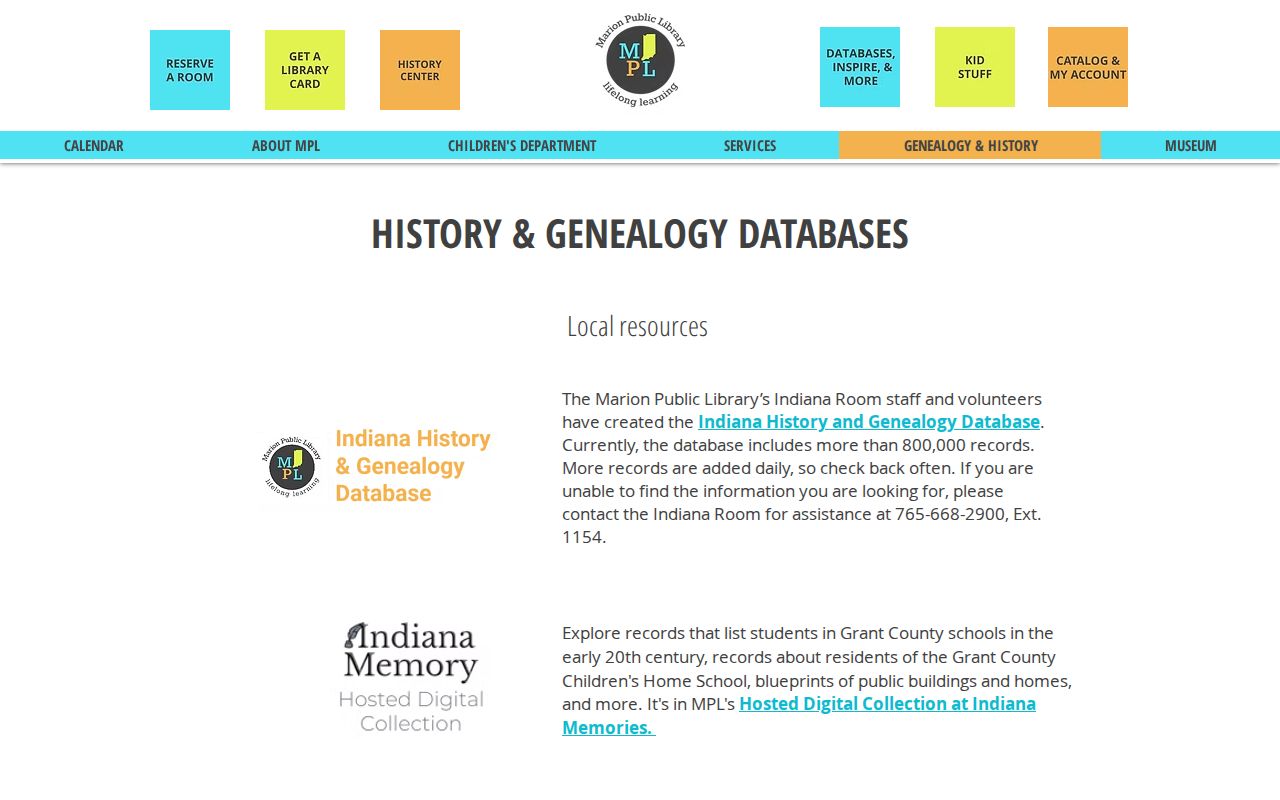
The library reports a local database count above 800,000 on one page and above 900,000 on another, with records added daily. Treat that changing count as a sign to search again, not as a fixed collection total. A 1925-1934 common-school graduate record is a useful example: it can hold a student's name, age, school district, post-office address, grades, and teacher.
A former classmate search can move from that school record to a yearbook, newspaper item, photograph, and dated directory entry. The post-office address is historical evidence, not a claim of current residence. Marion's Roland L. Auble oral-history collection offers another path, with 64 Grant County veterans interviewed by Marion High School students from 1998 through 2004. These companion sources add context without forcing every name into a city directory.
Handle Marion Directory Gaps
A person may vanish because of a move, death, unlisted status, initial change, publisher change, or missing volume. Search the address index and alphabetical list. Then try a spouse, widow notation, business name, street abbreviation, or nearby year. Telephone books and newspapers can bridge gaps, though no Marion-specific telephone-book year list was located.
Move from the last directory appearance to an obituary or funeral abstract, then a probate or cemetery index. The State Library inventory specifically lists probate index Book 4 as missing. That known gap means a negative film search is not proof that no estate existed. Check the clerk's books, other probate indexes, state archives, and local vertical files before closing the trail.
Street labels also changed. Early references may use Grant Court House, the post-office name before Marion in 1836. County histories and Sanborn maps can help align an old address with a later block.
Trace Families in Marion Directories
City directories give dated street-level sightings; federal census schedules give household relationships and other details at a different date. Pair them without treating either as exact proof for the other. Public census images through 1950 follow the 72-year release rule, and their enumeration boundaries may not match Marion city limits or directory coverage.
- Find the first known name or address. Copy the exact entry, page, year, title, and publisher.
- Search the nearest prior and next available volumes. Note moves, spelling shifts, spouse notes, and work lines.
- Use an address-order section when present. Confirm the result back in the alphabetical listing.
- Pair directory evidence with the nearest 1900 through 1950 census. Compare names and relationships while respecting the date gap.
- If the line disappears, search Marion newspaper, obituary, funeral, cemetery, and probate indexes.
For a current parcel or modern owner, hand the address to the Marion street directory workflow. For a backward chain focused on one property, use Marion past residents. The historical city directory remains the main source for connecting annual names with a street between census years.