
Marion Neighbors Across the Block
Public sources describe parcels, owners, civic areas, and older address entries around a Marion block. They do not publish a complete list of every person at each home. The most reliable neighbor lookup begins with the parcel map, then separates ownership from occupancy and present facts from historical ones. Each source below answers a different block question and has a different access limit.
| Source | What It Shows About a Block | Access |
|---|---|---|
| Elevate GIS | Adjacent parcels, IDs, map geometry, owner links | Dynamic online map; Assessor office fallback |
| Assessor property record | Owner, situs, sales, values, building card | Online or office; mailing address is separate |
| Recorder plats and deeds | Lot, block, subdivision, easements, title chain | Paid Tapestry, counter, or microfilm |
| Indiana Voters | One person's current registration match | Name, birth date, and county; no block browse |
| Neighborhood associations | Named civic geography and joining route | City page; no public member roster |
| Historical directories | Past occupants arranged by name or address | Library shelf, microfilm, licensed database |
An owner name can belong to a trust, business, estate, or person who receives mail elsewhere. It does not identify all occupants. A voter match confirms registration for the named person under the portal's rules, but it is not a public street roster. For Marion neighbors, record what the source states and leave household relationships unstated unless a dated historical source supplies them.
Save the parcel ID and access date for every lot reviewed. That makes the comparison reproducible even when a mailing address, owner label or map display changes later.
Select a Marion Parcel
Open the Grant County Elevate viewer on a desktop, search the subject address, and click its parcel. Record the parcel number, situs address, owner link, and legal description before moving outward. Situs means the parcel's physical location. A separate mailing address only shows where the tax statement goes. The county's Assessor page confirms that parcel information may include ownership, sales since 2008, annual value history, land, improvements, sketches, and photos.
The exact live controls and layer names were not exposed in the static research capture. No official text confirmed a radius, buffer, rectangle selection, bulk export, or dedicated neighbors button. Use the verified click-by-click method. If selection fails, call or visit the Assessor and ask about adjacent parcel information rather than claiming the map lacks it.
Map Marion Neighbors Parcel by Parcel
Keep the subject parcel selected and zoom until the whole block is visible. Marion blocks can include lots that meet at a rear line, corner parcels that front another street, parcels across an alley, and separate tracts under one owner. A parcel-by-parcel log prevents the closest map label from being assigned to the wrong lot.
- Copy the subject parcel ID, situs, legal description, and owner link.
- Click every touching side, rear, corner, and alley parcel. Log each parcel separately.
- Open the property information for owner and sales context. Keep the owner mailing address apart from situs.
- Read the plat or deed when an easement, shared lot, subdivision line, or noncontiguous tract makes the map unclear.
- Ask the Assessor for help if a parcel cannot be selected in the dynamic viewer.
This process covers the immediate block. The Marion street directory follows a whole named street through its complete address-record chain.
Note: A homestead or matching mailing address can support owner-occupancy context, but neither identifies every person living on the parcel.
Grant Plats Explain Marion Blocks
Map outlines become more useful when matched to a legal description. The Grant County Recorder keeps plats, surveys, deeds, annexations, easements, and other land instruments. Tapestry offers paid search and images, while the office counter and State Library microfilm provide fallback access. Older Grant land material reaches 1825, and deed books begin in 1831.
Use the lot, block, subdivision, plat, or tract wording to decide which parcels truly share a boundary. A deed can explain a shared drive or an owner name, but it still does not prove current occupancy. Keep the neighbor search focused on the block's physical and recorded layout.
Indiana Voters Are Not a Roster
The public Indiana Voters portal requires a person's first name, last name, date of birth, and current registration county. It is built to check one voter, polling place, and ballot information. It cannot be browsed by Marion street or block. Indiana also does not register ordinary voters by party, and a ballot choice is not a public lookup.
A fuller computerized voter product uses the official VRG-24 process with county, township, precinct, vote-history, or walking-list choices. Qualifying purchaser and use rules, fees, non-sale terms, and no-solicitation certifications apply. Protected information is withheld. No public Marion block roster was found, so neighbors should never be inferred from a voter list that the public portal cannot produce.
Marion Neighborhood Associations
Marion's City Development inventory treats associations as geographic groups for city communication, projects, and shared concerns. Residents may join an existing group or form one. The city names a coordinator, but it does not publish a member or household directory.
| Marion civic area | Other named areas | Public information |
|---|---|---|
| Andrew Manor | Bend of the River, Brinker Heights | Named association and city contact route |
| Center City | College Park, Euclid, Garfield | Geographic civic group, not a resident roster |
| H.O.P.E./South Marion | Harry Cramer, Historic Marion | Community projects and concerns |
| Lincolnshire | Maplewood, Martin Boots, Northeast | Joining or forming guidance |
| MHS/Frances Slocum | Quarry Triangle, Shady Hills, Soap Box Derby | Neighborhood name and city liaison |
| Sunnycrest/Westlea | The Village, University Village | No public household directory |
| West Marion Homeowner's Watch | Named civic group with local history |
These labels help place a block in civic geography. They should not be confused with ZIP codes, wards, parcels, census areas, or city limits.
A Marion Twelve-Block Story
West Marion Homeowner's Watch grew from neighborhood-watch roots and evolved in 2017 around a 12-block area. Andrew Manor's association began in 2007 and reports meetings from March through October. These examples show how Marion neighbors organize around communication and place, not how to obtain a list of private household members.
The city inventory is the current route for group information. Older PDFs or news pages can explain the group's history, but an old meeting reference should not be treated as a current contact list.
Marion Community Files Add Context
Marion Public Library's Indiana History and Genealogy room holds church, Quaker, surname, family, military, newspaper, photo, cemetery, and local history files. The Grant County Historical Society also maintains books and vertical files, with research routed through the library. These collections can explain an older block or connect a dated name to a school, congregation, or event without claiming that person remains nearby.
A concrete example appears in the Indiana Memory common-school graduate record.
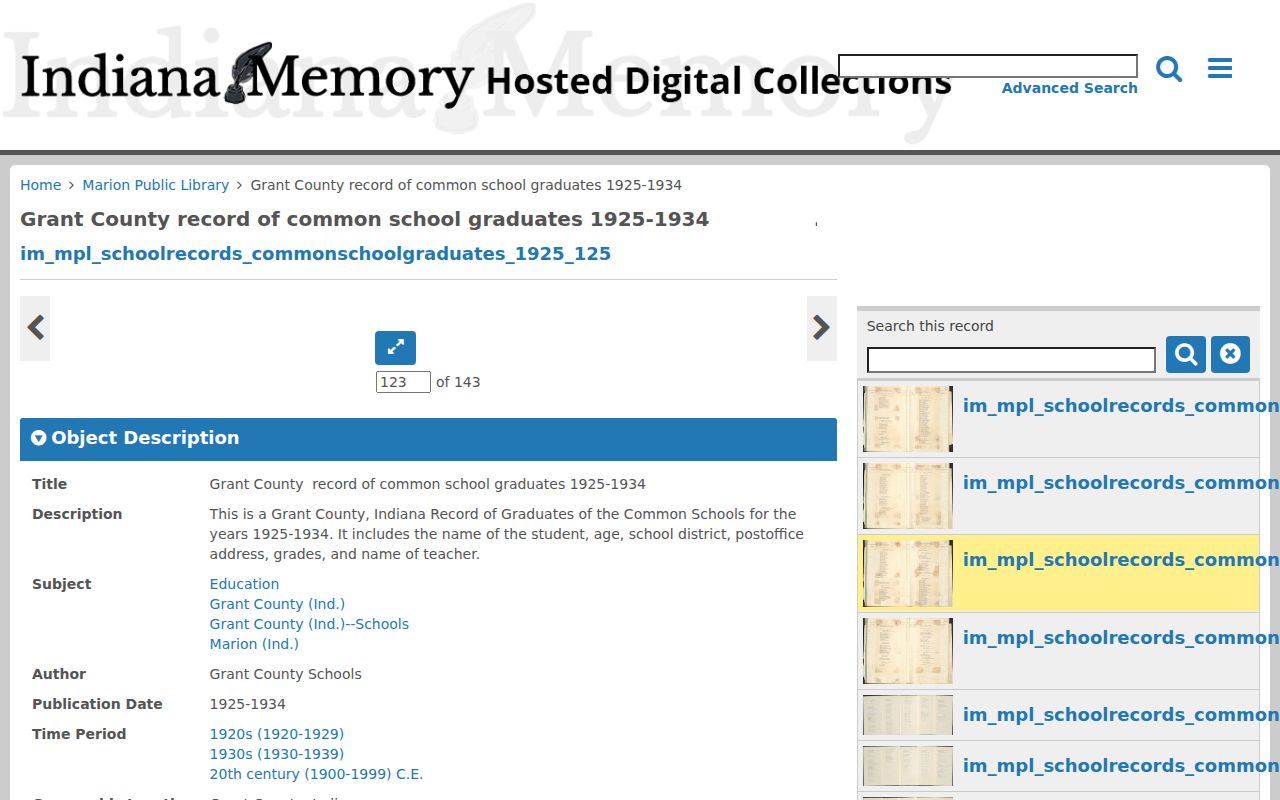
The historic item includes a student's name, age, school district, post-office address, grades, and teacher. Its address is a period clue, not a current household statement.
Official Marion Records or Compilations
Commercial neighbor tools may combine old owners, phone associations, and purchased data. Their block lists can be stale or merge people with the same name. Official sources are narrower, but each has a known custodian and a defined purpose.
| Source type | Best use | Main limit |
|---|---|---|
| Official parcel and deed records | Ownership, parcel geometry, recorded transfers | Owner is not always occupant |
| City civic inventory | Neighborhood name and participation route | No member roster |
| Commercial compilation | Possible lead for further checking | Stale, merged, partial, or fee-gated data |
Verify any compilation against the Assessor, Recorder, city association page, or another custodian. A private opt-out request does not erase a lawful public deed or parcel record.
Request Existing Marion Block Records
No public index was found for Marion permit, code, or neighborhood files by address. The city's APRA page provides a route to request an existing record. Give the block, exact address, department, record type, date range, and desired medium. Ask for a permit, inspection, zoning, code, meeting, or project record that the city already holds, not for officials to create a neighbor list.
The captured image below comes from Grant County's current-inmate table, a separate official record with limited visible fields.
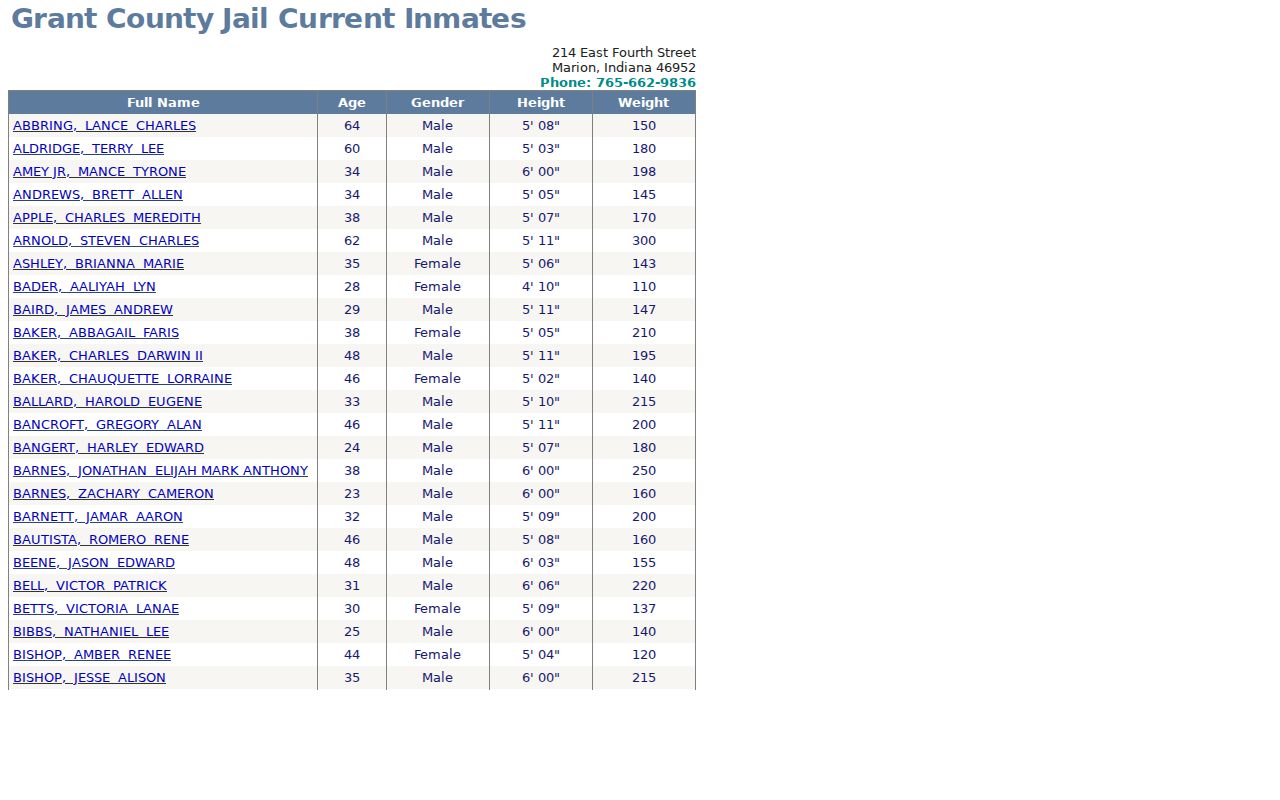
That table demonstrates why sources must stay in scope: a name, age, and physical description in a current custody list says nothing about who occupies nearby parcels.
Privacy for Marion Neighbors
Parcel rolls do not list every renter, child, visitor, utility customer, or delivery account. Courts can seal or redact records, and birth, adoption, and voter data have their own limits. Indiana's Address Confidentiality Program gives qualifying survivors a secure substitute address and protects voter identifying information. It does not erase every older lawful record, but a normal public directory should not expose the participant's actual address.
The Indiana Attorney General's Safe at Home page explains the program. Public property address restrictions can also apply to certain eligible officials under separate Indiana rules. Respect those protections and do not try to connect hidden fields through another source.
Lawful use. Use Marion neighbor records for civic awareness, history, reconnection, or personal safety. Never use them to watch, intimidate, stalk, or harass anyone.
Note: The safest Marion neighbor lookup records only what a dated official source proves and leaves private household details alone.