
Build a Marion Resident Trail
Begin with the strongest fact already known. For an address, the Grant County Assessor and Elevate map identify a parcel, legal description and recorded owner. For a person, Indiana Voters, Indiana MyCase, INBiz and the Professional Licensing Agency can provide separate identity clues. For someone who lived in Marion decades ago, start at the Marion Public Library's directory and newspaper collections. Each source answers a narrow question; none is a complete roster of everyone living in the city.
A reliable Marion residents directory search compares two or more keys: full name plus date of birth, street address, parcel number, court number, business name or directory year. Ownership does not prove occupancy, a mailing address can differ from the property's physical or situs address, and a filing address can belong to an organization. Record the access date and follow the source back to its custodian before treating a match as conclusive.
- Search the Grant County Assessor by owner or property, then open the parcel in Elevate.
- Use Indiana Voters with the person's exact name, birth date and current-registration county.
- Follow ownership changes through the Grant County Recorder's grantor/grantee index and recorded deed images.
- Use Marion city directories, newspapers, yearbooks and local indexes for a dated historical connection.
- When no public portal covers the record, request an existing record from the responsible city or county office under APRA.
Where Marion Keeps Resident Records
Most citywide evidence is held by Grant County. The Recorder keeps deeds, mortgages, plats and related instruments; the Assessor maintains parcel ownership and valuation records; and the election office handles registration records. The Clerk at the courthouse is the official source for court files, marriage licenses and probate matters. Marion city departments hold their own permits, code files and public-business records. For address-by-address technique, use the Marion street directory.
Read the Assessor's Owner and Situs Fields
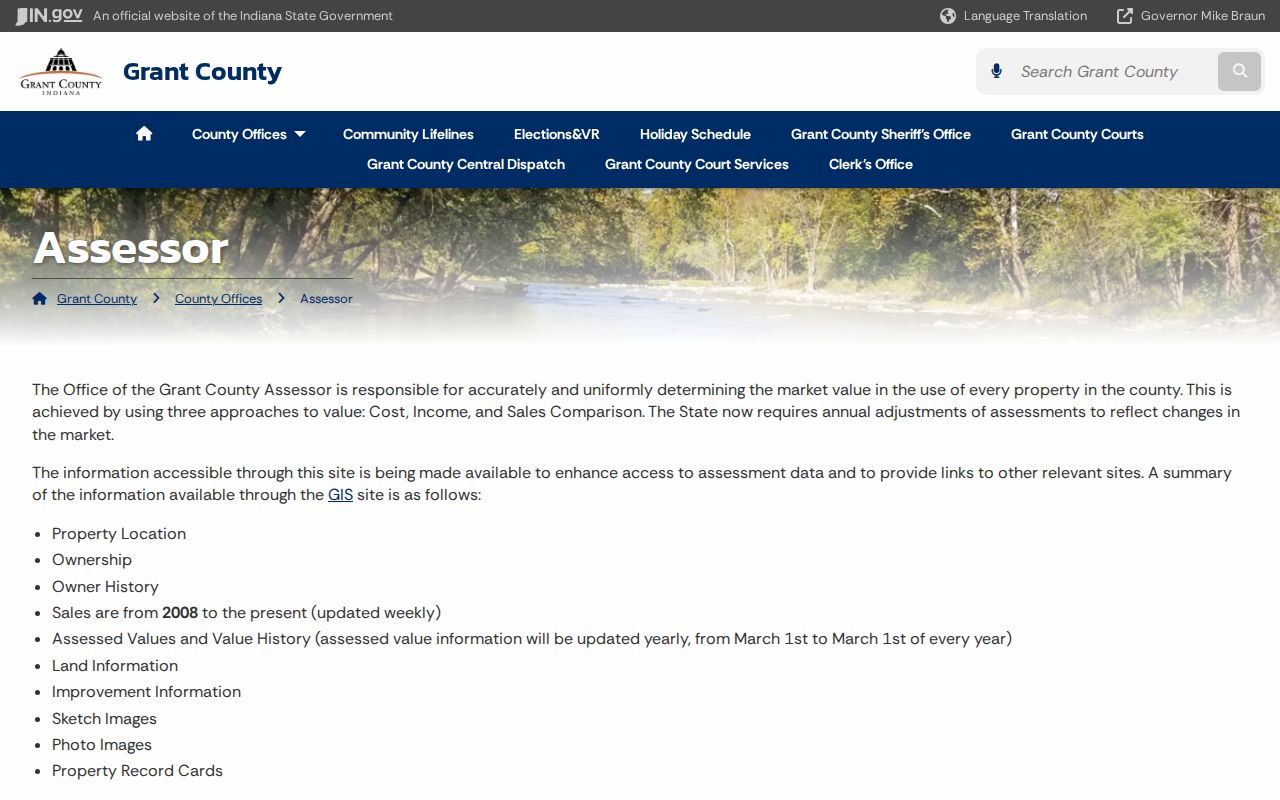
The assessor describes its public search as an owner-name and property search. Elevate adds the map connection needed to distinguish similarly named streets or adjoining lots. A useful parcel note contains the address exactly as displayed, parcel ID, legal description, recorded owner, values, sale information, and the day searched. The research confirms sales information from 2008 forward and an owner-history function, together with a property card, sketch and photograph where available.
The Assessor's official page is the best starting point for the public system. The captured portal view below shows the source behind this part of the Marion residents directory.
Use the parcel result as an ownership lead, not a list of household members. The Treasurer also warns that tax statements go to the destination on file, which may be different from the physical parcel. Search with the street number alone when Ninth versus 9th or East versus E prevents a match, then have the Auditor correct an erroneous property address.
Indiana Voters Confirms a Registration Match
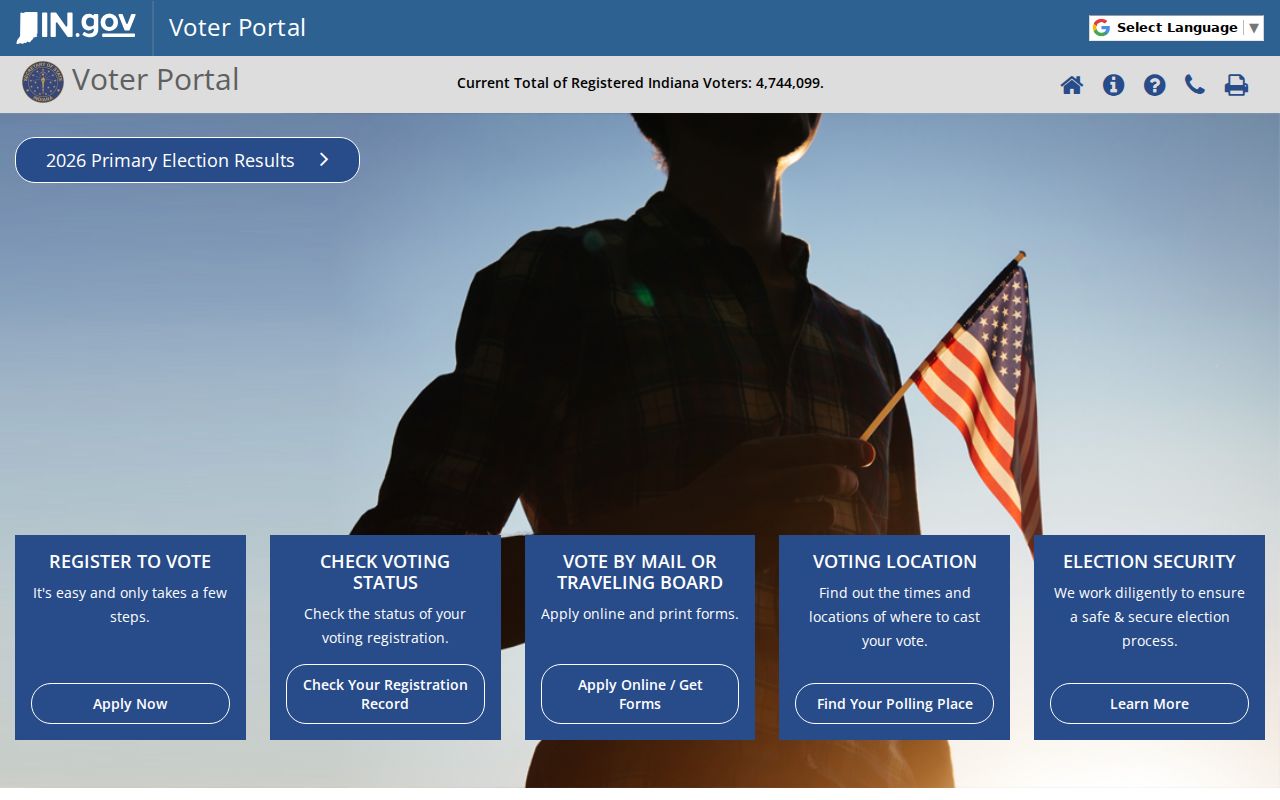
The public Indiana Voters portal asks for first name, last name, date of birth and the county of current registration. Enter the name exactly, and omit a suffix unless it is part of the record. A “voter not found” response can reflect a spelling, date or county mismatch; it is not proof that a person never lived in Marion. The public result establishes registration status, not party registration or a street-by-street roll.
The portal's form is visible in the official capture below. It is a useful identity cross-check because the required birth date separates people who share a name.
Bulk computerized voter information follows the VRG-24 request process and statutory restrictions. Protected voters and participants in the Indiana Address Confidentiality Program require special care. The Grant County Election Office is the local correction and access contact.
Current Marion Directory-Like Sources
Modern records identify people by a role: parcel owner, registered voter, party to a deed, court participant, business agent, licensed professional or current inmate. That narrower scope is more honest and useful than treating the Marion residents directory as a universal household list.
| Marion source | Connection shown | Official keeper | Route |
|---|---|---|---|
| Assessor and Elevate | Parcel owner, situs, values, sales | Grant County Assessor | Free web viewer and office |
| Indiana Voters | Current registration match | Indiana and county election officials | Person-based public form |
| Tapestry deed index | Grantor, grantee and instrument | Grant County Recorder | Paid search; counter and microfilm alternatives |
| Indiana MyCase | Named party and public docket | Indiana courts; Clerk is official | Free search and clerk file |
| INBiz / PLA | Business or credential affiliation | Indiana state agencies | Free public search |
The Marion resident lookup explains how to compare these roles without merging people who share a name. It also covers vital indexes and restricted sources. A current inmate list or offender search has a specific public-safety function and should never be treated as evidence about an unrelated namesake.
Trace a Marion Owner Through Recorded Deeds
The Grant County Recorder indexes deeds, mortgages, plats and other instruments. Start with the assessor's current owner, search that person as grantee, open the deed, identify the grantor, and repeat backward. Lot, block, subdivision and legal-description terms become important when a street name changes or an older document lacks the modern address.
Tapestry is the linked paid service; image viewing is included with a paid search and printing costs extra. The courthouse counter remains available. For older work, Indiana State Library microfilm lists deed books beginning in 1831, grantor/grantee indexes for 1832–1899, a Center Township deed index for 1831–1926, and a tract book for 1825–1857. “Not online” therefore does not mean “no record.”
Four terms to keep separate. A parcel is the assessor's mapped tax unit. The situs is its physical location. A plat lays out lots and streets. A criss-cross directory is arranged for address searching rather than only by surname.
Use MyCase for a Public Court Trail
Indiana MyCase serves Grant Circuit Court, Grant Superior Courts 1–3, Grant/Gas City Court and Grant/Marion City Court. Search tabs cover case, name and attorney. The name search supports sounds-like matching and a wildcard, with status, filing-date and court filters. Broad searches can stop at 1,000 results, so add a middle name, date range or court when possible.
A public docket can show a party name, case number, court, status and chronological events, but the Grant County Clerk's file is authoritative. Sealed, confidential and nonpublic material will not appear. Ask the Clerk about access, copies and certified records rather than assuming an absent web result ends the search.
Marriage, Birth and Death Clues in Grant County
Indiana's public Marriage License Public Lookup covers 1993 to the present. Certified marriage and divorce records come through the county Clerk, while the Grant County Health Department at 401 S Adams Street handles local birth and death records. Indiana Department of Health records begin in October 1907 for births and 1900 for deaths; application, identification and direct-interest rules apply.
Birth certificate information is generally restricted for 75 years, and adoption records are confidential. Historical researchers can turn instead to Marion Public Library marriage, cemetery, funeral and obituary indexes, including local marriage microfilm from 1831–1957. A death notice or probate reference can connect relatives and a last address, but it remains dated evidence rather than proof of a current home.
Marion Business and License Cross-Checks
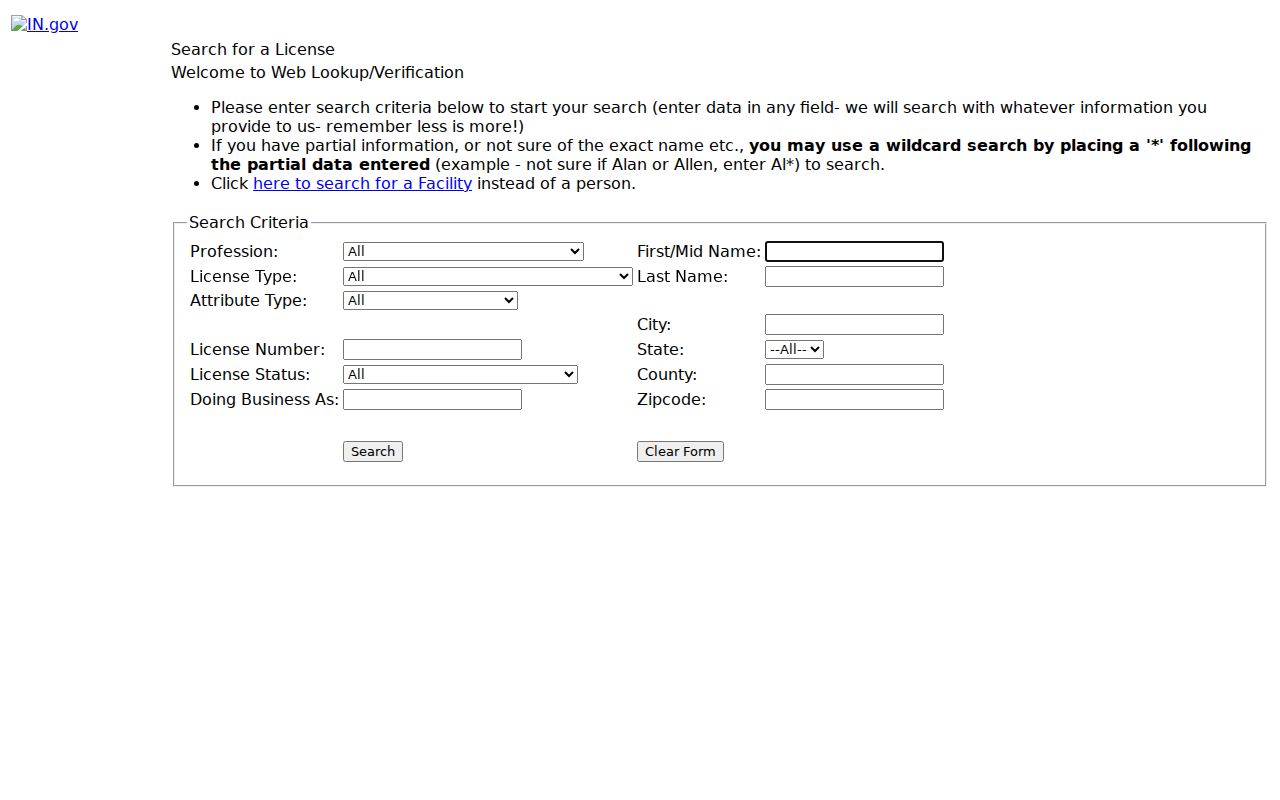
INBiz can return an entity name, status, registered agent, governing people and filing addresses. The Indiana Professional Licensing Agency verification search checks credentials by the available name or license fields. These records help distinguish people and confirm a dated affiliation, but a registered-agent, office or license address is not automatically a residence.
The PLA search surface is shown below as one example of a role-based official directory.
Compare a result with a middle name, credential number, business filing or another official record. This is especially useful for verifying the identity behind a service or transaction without stretching the record beyond what it states.
What Marion's Official Trail Leaves Private
No official public source supplies every person at a parcel. Non-owner occupants, utility and delivery accounts, motor-vehicle addresses, protected voter details, confidential adoption files and Address Confidentiality Program information fall outside an ordinary directory search. The live Grant County jail table displays limited physical descriptors but is not a searchable history of every booking, charge or bond.
Indiana's Address Confidentiality Program, also called Safe at Home, supplies a substitute secure mailing address to qualifying survivors who apply with a trained advocate. Government and private first-class mail is forwarded, and protected voter details are treated as confidential. It is not witness protection, cannot erase every older document, and does not guarantee physical safety. Its existence is a reminder to stop when an official system withholds an address rather than trying to defeat the protection through unrelated records.
Use records lawfully. Public availability is not permission to stalk, harass, threaten or harm someone. Restrict a Marion residents directory search to legitimate personal, genealogical, property, estate, civic or safety purposes, and verify sensitive conclusions with the custodian.
ZIP 46952 and 46953 Are Postal Clues
Marion City Hall at 301 S Branson Street and the courthouse at 101 E 4th Street anchor official addresses in 46952. The Grant County office complex at 401 S Adams Street and Marion Public Library at 600 S Washington Street use 46953. Those examples do not define complete ZIP boundaries. ZIP codes organize mail delivery and do not perfectly describe city limits, parcel jurisdiction or a neighborhood.
Use the USPS ZIP Code Lookup for city-and-state discovery, then verify an exact address and unit. The Marion ZIP directory explains why a ZIP filter varies among property, voter, business and license systems.
Request Marion Records When a Portal Stops
Indiana's Access to Public Records Act, IC 5-14-3, provides the request framework for existing public records. Marion's public-information request route asks for contact information and up to four descriptions. The researched city instructions state $0.10 per page, $10 per audio copy or case, and up to 14 business days; a denial must be written and identify its grounds.
Direct the request to the department that keeps the file and describe the record, date range, address, subject and preferred medium. County offices also publish phone, email, mail and counter routes. APRA does not require an office to create a new resident list or answer a question; ask for an identifiable existing document.
Historical Marion Residents Directory Shelf
Marion Public Library describes a local directory run from 1887 to the present. The Indiana State Library identifies specific Marion and Polk volumes, including 1903, the 1908–09 Grant County directory and gazetteer, and selected Polk years from 1909–10 through 2015. Do not infer that every intervening year survives. The exact reverse or criss-cross coverage remains a research gap, so ask library staff which volumes include an address section.
The Indiana Room at 600 S Washington Street also offers Marion newspaper microfilm from 1867 forward, yearbooks, cemetery and funeral resources, local photographs and in-house Ancestry access. Its database is described on different library pages as holding more than 800,000 and more than 900,000 entries, while more than 5,100 historic photographs have been indexed or digitized. The Marion city directory collections guide lists the confirmed runs and how to read an entry.
A historical directory line may give name, street, occupation, household notation and owner-or-occupant marks according to that volume's key. Samuel Plato's Indiana marker demonstrates the page-locator method with citations to 1908–09 page 323; 1919 pages 406 and 717; 1921 pages 445 and 733; and 1923 pages 353 and 592. Inspect the image before transcribing. Pair the dated line with census, deed, newspaper or probate evidence; the State Library's Grant probate inventory notably lists Book 4 as missing.
Local geography can also solve what looks like a failed identity match. Marion's first lots were laid out in 1831, and the post office was known as Grant Court House before the Marion name took over in 1836. The city incorporated in 1889. A nineteenth-century record using the older postal name may therefore concern the same community. Sanborn fire-insurance maps cover Marion years from 1887 through 1952, with 18 sheets in the Library of Congress's 1893 set; these maps explain structures and lot arrangements but do not name every occupant.
For a former classmate or relative, combine the directory year with Marion school records, yearbooks, newspaper microfilm and the library photograph index. One Indiana Memory sample for Grant County common-school graduates from 1925–1934 includes student name, age, school district, post-office address, grades and teacher. That address is historical and may describe a postal place rather than a modern situs. The Auble oral-history collection adds interviews with 64 veterans and Marion High School work from 1998–2004. These dated collections offer rich connections without claiming where someone lives now.
When research must be done remotely, library staff can help identify a source before a paid request is placed. The researched service permits as many as ten records at $2 each. Provide a surname, approximate year, title or page clue instead of asking staff to search an unlimited period. Fairmount News microfilm runs from 1888–1910 with an index, although 1893–95 is unavailable; that kind of explicit gap is evidence to change sources, not permission to fill the missing years by assumption.